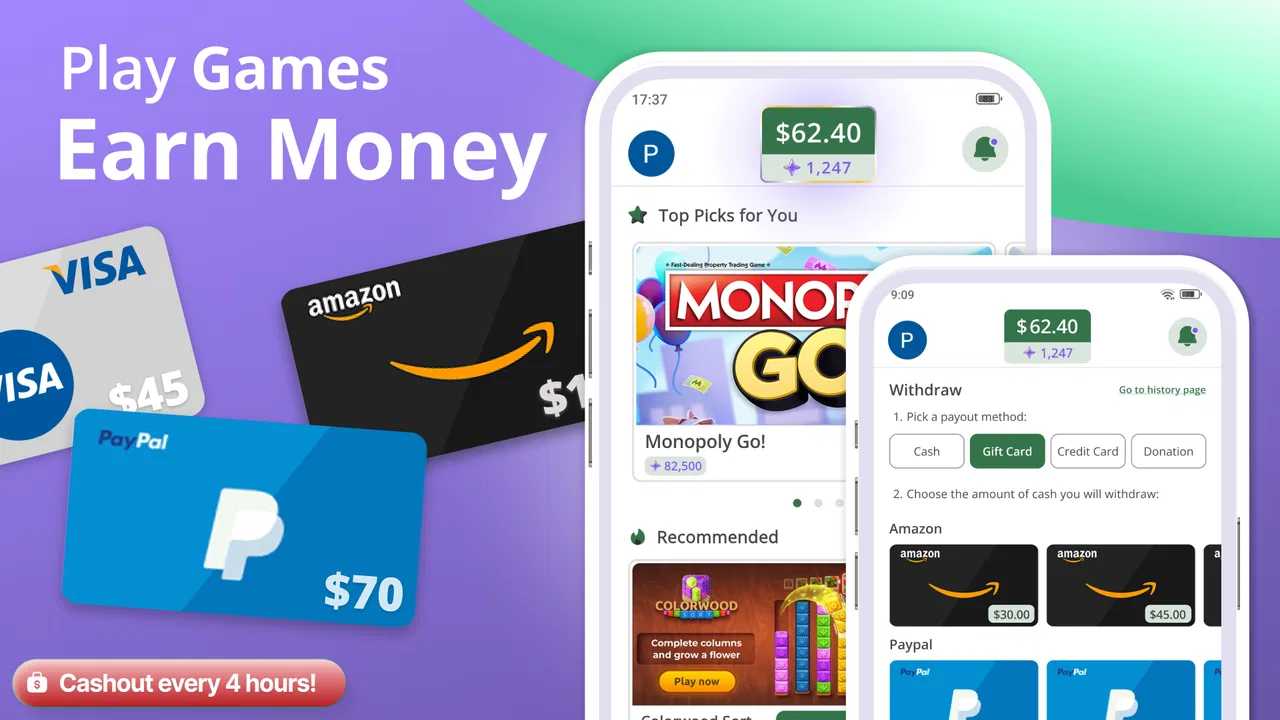
myCashery: Play & Make Money
- 4.5
- Rating
- 500.00K
- Installs
- Free
- Price

 Analysis by App-foxy
My first impression of myCashery was that it is less about finding one magical way to make money and more about turning spare phone time into small earning opportunities. The central idea is simple: you play available games and complete surveys, then work toward rewards. That makes it a lifestyle app with a very particular audience—people who already spend time on their phone and would rather attach a modest earning goal to that habit.
I want to set expectations clearly from the start. I would not treat this as a replacement for a job, a dependable side income, or a shortcut to quick cash. I see it as a low-commitment option for filling short gaps in the day. The difference matters because the app becomes much more useful when I judge it by the right standard: not “How much can this replace?” but “Is this a better use of idle minutes than casually scrolling?”
Developed by ayeT-Studios, the app is free and aimed at mature users aged 17 and above. It has built a sizeable audience, with over 500 thousand installs, an average rating of 4.5 from around 17 thousand ratings, and roughly 2 thousand written reviews. Those figures suggest that the basic concept connects with many users, although popularity alone does not make every earning opportunity equally worthwhile.
You May Also Like

 Blood Strike: 2.5 Anniversary
Blood Strike’s Loadouts Turn Every Drop Into a Tactical Gamble
A close look at Blood Strike’s custom loadouts: how fast access to signature weapons reshapes its battle royale rhythm, rewards preparation, and narrows the gap between fights.

 Pandora - Music & Podcasts
Pandora’s Music Is Easy to Start, but Harder to Recover
Pandora’s strength is its low-effort path from a seed to a station. Its weak spot is how much confidence it asks you to place in connection, setup, and quiet recovery.

 8 Ball Pool
 Is Built on Rivalries, Rematches, and Routine
A close look at the rivalries, rematches, shared routines, and unanswered safety questions that turn a quick pool match into a persistent mobile community.

 Samsung Music
’s Quiet Strength Is Playing What You Already Own
Its reach comes less from spectacle than from dependable access to a personal library. That simplicity is both the app’s strongest retention engine and its ceiling.

 AccuWeather: Weather Radar
AccuWeather Review: A Quick, Clear Forecast for Everyday Decisions
For everyday plans, the best forecast is the one you can understand quickly. AccuWeather makes rain timing, radar, and local conditions easy to act on, with a few trade-offs.

 Hill Climb Racing
Why Hill Climb Racing Still Turns Crashes Into One More Run
A tiny car, a bumpy hill and one more upgrade: Hill Climb Racing keeps resurfacing because its simple chaos makes every near-miss feel personal.
More From Our News Desk
View All News


Why the play-and-survey combination matters
The most important capability here is the combination of game-based earning and survey completion in one place. Many reward apps focus heavily on one activity, while myCashery gives me two different ways to use the same spare period. That flexibility is more meaningful than it sounds. A game offer may suit me when I have time to play, while a survey may be more practical when I am waiting somewhere and want a shorter task.
Games provide the more engaging route, but they can also demand patience. Surveys are usually easier to understand as a task, yet they depend on whether I match the questions being offered and whether I am willing to answer carefully. Having both choices lets me switch instead of forcing every session into the same routine.
In practice, I would approach the app as a task-selection tool rather than as a game collection. The entertainment is useful, but the real question is whether the time required by an activity makes sense for the reward attached to it. That is the first non-obvious lesson: the value comes from choosing efficiently, not from staying active for as long as possible.
This changes how I would use the app compared with a normal mobile game. In a regular game, progress is usually the reward. Here, progress only matters if it connects to the earning objective. I would therefore pay attention to the requirements of each available activity before starting, rather than opening the first game that catches my eye.
The same principle applies to surveys. I would read the opening questions carefully and answer consistently. Rushing through a survey simply because it looks short can waste more time than it saves if I am screened out or lose interest halfway through. The app is best approached with a little discipline, even though the activities themselves are casual.
What using it feels like in ordinary phone time
A realistic example would be a weekday evening when I have fifteen or twenty minutes before dinner. I might open myCashery, look at the available game tasks, and decide whether one fits that limited window. If the game requires a longer commitment than I can give, I would switch to a survey instead. The benefit is not that every session produces a dramatic result; it is that I can make a deliberate choice instead of spending the same minutes on an activity with no earning goal at all.
Another useful situation is a commute or waiting room, provided I have enough attention for the task. Surveys can fit better into these short gaps than games that require sustained play. I would avoid beginning anything that needs concentration if I know I will be interrupted, because an unfinished session can make the experience feel inefficient.
At home, the game side may be more appealing. I can give it a longer, uninterrupted period and see whether the required progress feels reasonable. Still, I would not let the earning angle persuade me to continue a game I genuinely dislike. If the activity feels like work without enough personal enjoyment, the trade-off becomes weaker than simply choosing another leisure option.
This is where the app’s lifestyle category makes sense. It sits between entertainment and small-task platforms. I am not opening it purely to relax, and I am not using it like a professional work tool. The best fit is the space in between: light activity with a possible reward attached.
A practical routine that avoids wasted time
I would use a simple three-step routine. First, I would scan the available activities and identify which ones match the time I actually have. Second, I would choose one task and stay focused instead of jumping between several options. Third, I would stop when the activity no longer feels worthwhile. This routine sounds basic, but it prevents the common mistake of treating every available offer as automatically valuable.
For games, I would make a note of the progress point I am aiming for before I begin. That gives the session a clear endpoint. Without one, it is easy to keep playing because I have already invested time, even when the remaining effort no longer feels attractive. This is a classic sunk-cost trap, and reward apps make it especially easy to fall into.
For surveys, I would answer from my actual experience rather than guessing what might qualify me. Honest, consistent answers make the process less frustrating and avoid turning a short task into a confusing one. I would also reserve surveys for moments when I can read properly; doing them while distracted is likely to make the experience feel slower.
A further tip is to separate entertainment value from earning value. If I would play a particular game anyway, any reward opportunity feels like an extra benefit. If I would never choose that game without the incentive, I need to be stricter about the time involved. This distinction helps me decide whether myCashery is adding value or merely changing the label on time I would have spent elsewhere.
Where the app is strongest
The strongest use case is for people who have irregular pockets of free time. Students between classes, commuters waiting for transport, or anyone who regularly spends short periods on a phone may appreciate the ability to choose between games and surveys. The app does not require me to commit every day, so it can remain a casual option rather than another obligation.
It also suits users who enjoy trying different mobile games but want a reason to move on when the novelty fades. The earning structure can give a session more direction. Instead of downloading a game, playing briefly, and forgetting it, I can decide whether the available objective is worth pursuing.
Someone who dislikes surveys may still find value in the game side, while someone who does not want to spend time learning a new game can favor surveys. That choice is the real advantage of the combined format. It gives me a way to adapt the app to my mood and available time instead of committing to one type of task.
However, I would not recommend it to someone who needs predictable income. The amount of time I can spend is not the same as the value I receive from that time. Availability, personal interest, and patience all affect the experience. Anyone expecting a fixed return for a fixed number of hours is likely to be disappointed.
The trade-off between fun and efficiency
The game element makes the app more pleasant than a platform built entirely around questionnaires, but it also creates a temptation to overplay. A normal game can be enjoyed without calculating every minute. With myCashery, I may start thinking about whether the next stage is worth continuing. That can reduce the relaxed feeling that makes mobile gaming appealing in the first place.
Surveys create a different kind of friction. They can be less entertaining, and their usefulness depends on whether I find a suitable opportunity. Even when a survey is available, I still need to decide whether its length and effort fit my current situation. The app gives me options, but it does not remove the need to evaluate them.
There is also a psychological trade-off in using rewards as motivation. I may try a game I would not otherwise choose, which can be a pleasant discovery. On the other hand, I may continue after the fun has gone because I feel committed to reaching a target. My advice is to treat the reward as a bonus and keep a personal stopping rule. If the activity stops being enjoyable or reasonable, I would move on.
The free price lowers the barrier to trying it, but “free” does not mean costless. My time, attention, mobile data, and battery are still resources. I would use a Wi-Fi connection when possible and avoid opening the app during moments when I need to conserve battery. These are ordinary considerations, yet they are important when the expected benefit is modest.
Another trade-off is focus. Switching between several activities can make the app feel busy rather than helpful. I would rather complete one suitable task than start multiple offers without finishing any. That approach also makes it easier to judge whether the experience is genuinely worthwhile for me.
How it compares with familiar alternatives
Compared with ordinary mobile games, myCashery adds a practical motivation, but it may reduce the freedom to play purely for fun. A standard game is usually the better choice when I want deep progression, a strong storyline, or a polished long-term hobby. The reward-focused approach is better when I want short sessions and a reason to experiment.
Compared with survey-only apps, this one has more variety. I can change activities when answering questions becomes tiring. The compromise is that games may require more time and attention than a quick questionnaire, so the broader choice does not automatically mean greater efficiency.
Compared with passive scrolling, the app offers a clearer purpose. I can enter a session knowing that I am trying to complete a specific activity rather than simply filling time. Still, passive entertainment may be preferable when I am tired and do not want to read instructions, play, or provide answers. Not every idle moment needs to become productive.
Compared with a conventional side job, the difference is much larger. A job offers defined responsibilities and a more dependable relationship between time and payment. myCashery is casual and flexible, but that flexibility comes with uncertainty about how rewarding any particular session will feel. I would use it as a small optional activity, never as a financial plan.
Important details before installing
The app is free to download and use, which makes experimentation straightforward. It was released on April 29, 2024, and its current version is 2.0.10. It supports devices running Android 8.0 or later. Those details make it accessible to many existing phones, although anyone with an older device should check compatibility before planning around it.
The mature 17+ rating is another detail worth taking seriously. I would not treat the app as something for younger children simply because games are involved. Parents choosing apps for a household device should keep the age classification in mind and consider whether the reward-and-survey format is appropriate for the intended user.
Because the app involves earning activities, I would also read each task’s instructions before committing time. The store summary explains the overall purpose, but the practical decision happens inside the individual activity: how much effort it asks for, whether it suits my schedule, and whether I actually want to do it. That habit is more useful than assuming every option has equal value.
I would also keep my expectations modest during the first few sessions. Rather than judging the app by one unusually good or disappointing activity, I would test both sides of the format. A short survey session shows whether I enjoy the questionnaire workflow, while a game session reveals whether I am comfortable with longer progress-based tasks. After that, I could decide which side deserves most of my attention.
Who will get the most from it
The best audience is someone who already enjoys casual games, has spare moments throughout the week, and understands that small rewards require patience. This person can benefit from switching between activities without expecting every session to feel equally productive. The app is especially sensible for users who want a little structure around phone time but do not want a demanding commitment.
It may also help people who find survey platforms repetitive. The ability to move toward game activities gives the experience a change of pace. Conversely, users who prefer direct questions and short tasks can ignore the game side when it does not suit them. That flexibility is more valuable for adaptable users than for people seeking one perfectly consistent workflow.
I would suggest skipping it if the main goal is reliable income, if you dislike reward-driven games, or if answering surveys feels intrusive or tedious. I would also skip it if I know I tend to chase targets long after an activity stops being enjoyable. In that situation, the app could turn free time into an obligation rather than a useful alternative to scrolling.
My final view is positive but measured. myCashery works best as a flexible pocket-time app, not as a financial solution. Its play-and-survey combination gives me a meaningful choice between entertainment and short-form tasks, and that is more useful than a single-purpose reward app when my schedule changes from moment to moment.
I would recommend trying it with a clear boundary: choose activities deliberately, track how much attention they require, and stop when the exchange no longer feels fair to you. If you enjoy casual games and want to attach a modest earning goal to otherwise idle phone time, it is worth exploring. If you need certainty, substantial income, or completely effortless rewards, a different category of service will suit you better.
FAQs for myCashery: Play & Make Money
01What is myCashery: Play & Make Money?
myCashery: Play & Make Money is a rewards app that lets users earn points or other incentives by completing activities such as playing featured games, trying applications, answering surveys, or reaching specific milestones. The available tasks can vary by country, device, and account. Before downloading, users should review the current offer list and reward conditions because earnings are generally supplemental rather than a dependable source of income.
02How do you earn rewards with myCashery?
After creating an account, you typically browse the available offers and select activities that match your interests. Depending on the offer, you may need to install a game, register for a service, complete a survey, or reach a stated goal within a certain period. Carefully read the instructions before starting, since tracking may depend on using the provided link and completing every requirement exactly as described.
03Can myCashery rewards be converted into real money?
The app is designed to provide redeemable rewards, but the exact options may differ according to your location, account status, and the current reward catalog. Available methods can include cash-equivalent payouts, gift cards, or similar digital rewards. Check the minimum withdrawal threshold, processing times, identity requirements, and any restrictions inside the app before spending time on an offer.
04Is myCashery safe and free to use?
Downloading and using a rewards app may be free, but some third-party offers promoted through it could involve subscriptions, purchases, trials, or requests for personal information. Read each offer’s terms carefully and avoid entering payment details unless you fully understand the conditions. Also review myCashery’s privacy policy, permissions, and user feedback before deciding how much personal data to share.
05Why might an offer or reward not be credited?
Rewards may fail to appear if an offer was not opened through myCashery, the required permissions were disabled, tracking was blocked, another account had already completed the promotion, or the instructions and deadline were not followed precisely. Using multiple devices, VPNs, ad blockers, or reinstalling an app can also interfere with tracking. Keep screenshots and confirmation details, then contact support if a valid completion is missing.
Pros
- Simple interface makes earning options easy to find.
- Offers several ways to collect rewards beyond playing games.
- Progress and earnings are clearly displayed in the app.
- Suitable for short sessions when you have spare time.
- Cash-out options give users a clear earning goal.
Cons
- Rewards may vary by country
- device
- and available campaigns.
- Some offers require significant time before crediting rewards.
- Earnings are modest and should not be treated as regular income.
- You may need to share personal details for certain tasks.
- Cash-out eligibility can depend on minimum thresholds and rules.

myCashery: Play & Make Money
Gallery